Saturday, February 11, 2012

To Improve the World

Mandala #30 Perfection
Do you want to improve the world?
I don't think it can be done.
The world is sacred.
It can't be improved.
If you tamper with it you'll ruin it.
If you treat it like an object you'll loose it.
There is a time for being ahead,
a time for being behind;
a time for being in motion, 
a time for being at rest;
a time for being vigorous,
a time for being exhausted;
a time for being safe,
a time for being in danger.

The Master sees things as they are,
without trying to control them.
She lets them go their own way,
and resides at the center of the circle.

Tao Te Ching #29


Prints of Mandala #30 Perfection by artist Diane Fergurson are available in her Etsy Shop.

Follow the daily updates of the Mind Body Spirit Marketplace on Facebook and Tumblr.


Monday, February 6, 2012

Mind Body Spirit Artist Series: Adam Fergurson

Some theorists maintain that as people grow older, they really don't change that much.  That they retain and emulate the initial characteristics and qualities that they had as a young child.  Through writing this interview series I've come across many artists who have said that they have "always made art" or that they "knew that they were an artist from an early age".  In my son Adam Fergurson's case, I can honestly say that by observing him literally through his entire life, that really is what happened.  Intelligent, engaging, confident and always inspiring those around him by pushing the envelope just a little further, Adam is a grown man now, an artist in his own right - blazing a unique trail down the path of life.  Always a pleasure to discuss art with, I hope you will enjoy this lively interview with him as much as I did.
                                                                                                                     ~ diane fergurson

Bloom
MBS:  Can you tell us a little bit about your background?  How you got started in art?

Adam:  As far as I can remember I have always made art, and can distinctly remember wanting to always "be an artist."  I can even recall being in elementary school in suburban Missouri, and aside from yearning to be the man to discover Bigfoot, I told all my teachers that I was going to art school for college, no doubts about it.  Having open minded and artistic parents I was always encouraged to make art, express myself, and the idea that being different was not only OK, but was very cool, was ground into my brain regularly.  As a result while the other kids played soccer at recess I was often making pictures of what I now know were mini comics about The Blob, Dracula, and Wolfman.  My mother, also an artist, was teaching classes at a community arts center in downtown St. Louis while I was growing up and instead of hiring a babysitter would often bring me along to sit in her classes or signed me up for other programs happening in the building.  This gave me my introduction to "real artists" and the cultural plethora of things happening in the city.

I then moved to the northern New Jersey/ New York Metropolitan area around the age of twelve.  Suddenly I wasn't the only kid who was good at drawing and this drove me to be the best in my class.  I don't believe art should be competitive but I think its important to be around other artists in order to be inspired and driven to work harder.
I moved to Philadelphia in 2004 to attend The University of the Arts and have been in Philadelphia ever since.

MBS:  You mentioned having an introduction to "real artists" when you were at the 
community arts center.  What did you mean by "real artists"?

Adam:  I think my view of what "real artists" were as a child had a lot to do with admiring people who seemed to do their own thing, and made artwork because they liked doing it - regardless of what others may have thought.  As a kid I thought nothing was cooler or more admirable than being a rebel.  Along with my monster drawings, anything I ever drew that had a human in it involved Mohawks, tattoos, guitars, etc..  I still think one of the most rebellious acts one can do is to be an artist.  To have the gall to think you can bring something into the world in the face of all that has ever been, and then to think its valid and deserves to command attention is very rebellious.  I always felt any "real artist," if you will, blazes their own trail and is always one step ahead while the rest of the world follows the trail of candy they leave in their path.  I must note though that this statement does not imply that if you are not pushing the envelope that your work is not valid.  Art serves millions of purposes in millions of lives, but innovation and new ideas have to come from somewhere and I call that place the mind of the "real artist."

Six of Swords
MBS:  You're a sculptor, but also a painter and musician too.  Do you favor one medium over another?  Also, which comes first in the creative process for you when you are working?
The idea or the materials you use?

Adam:  I had a friend say to me once, "It's not what you do, but that you do." I think this holds up well with my own working practices.  I feel like so many artists I know get so hung up on an idea that they inhibit themselves from actually making the work.  I try and do the opposite when working on paintings. I often lay down several pieces next to one another and pour and splash mediums on all the surfaces until I feel as if something magical is taking place. At this point I separate the pieces from one another and deal with the consequences of my actions artistically by becoming more considerate of aesthetic formalities and composition as a whole.  I often go back and forth between these processes umpteen times on a single painting till I feel I have captured something.

As far as sculpture is concerned I apply this philosophy most often in my use of materials.  Living in an urban environment I am consistently confronted with waste and trash.  The same openness I bring to abstract expressionist chance practices in my 2D work, I bring to the discovery of materials from the street in my 3D work. I see something interesting, I take it, and then I look at it and let the inspiration flow.  The big difference between my 2D and 3D work has to do with the intensity of the battle which takes place between me and the work mentally. With 2D its more playful, where as with 3D and bringing objects from the mind into space I do much more racking of the brain.

Drumming has always served as a great place for collaboration and therapy for me.  As a teen, drums helped me release a lot of angst and stay out of (some) trouble by always playing music with friends. Currently staying active with three bands and teaching drums to addicts, I use drums as an excuse to connect the ideas of many - into a single.  Also to vent my frustrations, and to be with and collaborate with friends.  This gives me a calmness and piece of mind which I can then bring back into the studio to work on visual undertakings.

I have also used playing drums and being in bands as another outlet for my visual work.  With each project I am involved with I try to have a heavy hand in developing the visual aesthetic of the band, whether it's posters, logos, album covers, or even costume and face paint.  The thing that really strikes me about being a musician, is that music cannot be avoided.  You can have an art opening and have people be there but can't guarantee they are actually experiencing the work, meaning they don't HAVE to look at it.  With music its inescapable.  I am also working towards using drumming as a tool to reach transitory states of consciousness which I try to tap into when I create my visual work.
Phone It In
MBS: Spirituality combined with street art is reflected so strongly in your work, and in a manner 
that is much more then just style and content.  Could you discuss that a little bit?  Also, what are you referring
 to by the "transitory states of consciousness which I try to tap into when I create my visual work"?

Adam:  After moving from the suburbs in Missouri to the New York area I began to experience graffiti for the first time and I found it to be so alive and captivating.  I've had tags in the past and meddled with "getting up" but in reality I've always been more of a fan than participant. In my own work I think the graffiti aesthetic fits well, especially in my 2D work.  I work very fast and try to milk out as much expression as I can as quickly as I can.

Living in the city I don't know how an artist couldn't be inspired by graffiti. I see graffiti as energy manifested quickly and unfiltered.  When I say I try to achieve transitory states of consciousness while working, this is what I meant.  I am a clairvoyant, and am sensitive to different energies including those coming from the other side. When I'm working on my art my goal is to be so open that I don't even think about what I'm doing.  This way I can be the clearest channel possible, the work stays uncontrived, and the spiritual experience of creation can be felt by the viewer.  I often prepare my studio for this activity by regularly sageing and burning specific candles.

Tune in Every Sunday, #1 Magician
 MBS:  It's been my finding that mainstream art literature normally doesn't approach the 
subject of energetic connections in artwork.  It may be brought up in interviews with individual artists or it is often veiled in "inspirational quotes" from the old Masters, but not openly discussed.  Of course the opposite is true in non-mainstream art literature.  I know that often times artists who practice Reiki, for example, will automatically infuse their work with healing energy.  I also know that there is artwork that is created with purposeful non-positive intentions.  That, unfortunately, also comes through in the work.  As you mentioned, there is a real vibrancy and spontaneity in graffiti and street art.  What are some of your thoughts about energy and vibrations in artwork?
 
The Chariot
Adam:  Well let me first say that at this point in our culture I believe that spiritually based work has become taboo.  Attending art school and making spiritually based work was difficult for me because concepts which I would think endlessly about were quickly dismissed as too weird.  I was labeled a "stoner artist" by some of my peers, and there were professors I had who didn't know how to engage the work aside from formal aesthetics. That being said, and this interview aside, I have had to learn how to only hint and tiptoe around the themes of my work for the purposes of show proposals and artist statements with out making people think I'm nuts.

As far as energy imprinting I think you imprint energy in anything you make but it becomes stronger based on the amount of time and effort you put into the piece.  I am a level 2 Reiki healer and can't say I have consciously imprinted any of my work with energy, but I know its there.
 I look at the experience of creation more in the realm of riding the energy of the universe instead of creating it and putting into the work.  If the viewer has an energetic reaction to my work I want it to be because they feel a connection with the work organically, not because I have in some way willed it to happen or cast a spell on the work.  That is manipulation and against my spiritual morals.

As I was coming into my own spirituality I was very exited and told everyone about all kinds of things I was experiencing and learning, now I'm getting to the point where if someone wants to engage in that topic I am more than willing to have the conversation, but I'm not going shove it down peoples throats. I also think that since spiritual art is so taboo that sometimes the greater understanding can be achieved through the artist who doesn't put all his chips on the table.  By this I mean if you let the viewer figure out the spiritual correlations between the work and their own lives, they are more willing to expand their field of vision.  Most people simply do not want to be force fed anything, especially something as personal as spirituality.  This is the reason why I feel so many well known artists have had spiritual intentions, but don't necessarily make that known to their audience. They want them to figure it out themselves.

MBS: Video has also played center roll in many of your sculptures and installations.
  What is it about video as a medium that you find so compelling?

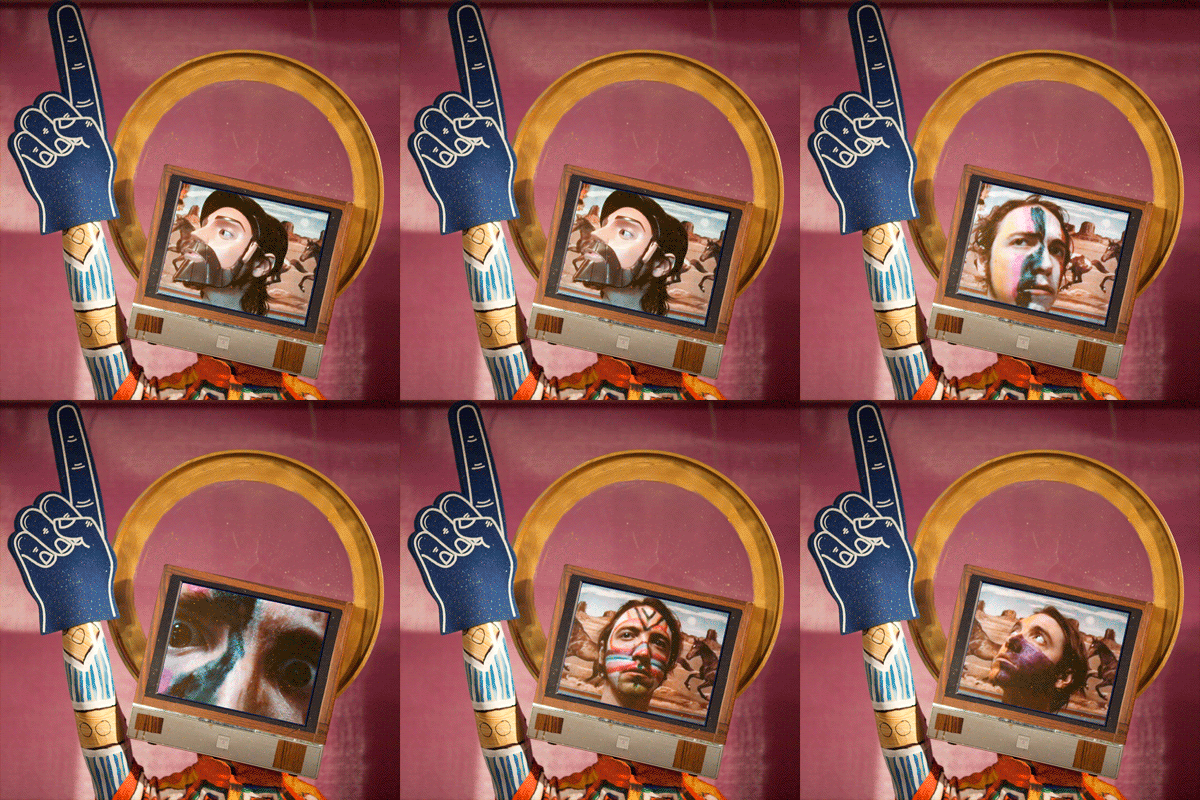
Adam: I am a very big fan of Nam June Paik (RIP) and his retrospective at the Guggenhiem was very inspirational to me.  What he did is that he has taken the big box we stare at in our living rooms and brought it into the gallery.  Instead of being something to "watch," the TV becomes a compositional element or an atmospheric meditation within a greater context.

I respond to this idea because much of my sculptural work and satirical work has to do with regurgitating the trash the media pumps out, which implies you should think and be a certain way.  In a society which makes its chapel the living room, it makes sense that the brainwash weapon of choice is the television. I think that it only fits that I use it to fight back to help others realize that this is what's happening.


Photobucket


Many times with my film work the narrative and story aren't the main focus. I try to create beauty foremost in order to get the viewer to understand the greater meaning of the piece.  In this way I look at the shooting process itself as very mystical and ritualistic, and the editing process similar to painting. It's a hard task to include video with other elements in a work because people are so trained to solely focus on the screen and anticipate a narrative.  This is why I admire Paik and his ability to make film and TV elements within in a larger concept.


MBS:  What is a typical work day like for you?

Adam:  I really enjoy and thrive on working with multiple pieces at once, so a typical day in the studio usually begins once I've decided which pieces I'm going to jump into first.  I will burn some sage, light a candle or two, put on some music and sit for as long as I need to with the work, until I feel drawn to a specific piece.  Music is also very important for me while I work.  It disconnects me from my own internal dialogue and allows me to tap into the creative source more easily and with less distraction.  I love listening to all kinds of music while I work but some favorites are Fela Kuti, Lee Scratch Perry, The Four Tops, Dungeon, and really cheesy commercial hip hop mixes.

My process isn't that far off from Paul McCarthy's "Painter," a favorite video piece of mine - but not really but really, ha ha. Since I tend to work quickly I often attack the work briefly and then either sit and contemplate the next move or continue to move around the room using the same paints, pigments, concoctions, or technique on another piece in the space. I also share studio space with friends so when I need a break there is someone usually around to get feedback from/ chew the fat with, which is important to me.  I don't try to limit myself to time frames either because I know my process well enough that when I force myself to work it doesn't come out how I'd like and I end up re-working it later.

MBS:  Ah, yes, McCarthy satirizing and ridiculing the "tortured artist" - pretty funny.  You mention saging and candle burning in your studio. What is the importance of ritual for you in your process?

Adam: I have a small alter in my space which holds various things. I often begin the creation session by saging because I want to clear the space of any negative energies which may be lingering around me or the space. Along with this I often light a white candle to further enhance purity of thought and intention, strengthen a connection to the divine, and to create ambiance.
Brain Rain
MBS:  What are you currently working on?

Adam:  I just recently finished a large installation at The University of the Arts Sculpture Gallery in Philadelphia called "Tune In Every Sunday."  The piece encompasses 2D, 3D, on site, and video work. I re-contextualized the language of tarot to an American Midwestern language, and created shrines empowering sports deities to portray the ritualistic and consumer culture of watching sports every Sunday in contrast to going to church.

Since the show has been up I have more space to spread out in my studio and have started to do more  painting again.  I feel like I'm the most at play when I'm painting.  Whether I have a show deadline or am finishing a specific body of work, or not, I always try to keep working all the time even if its just chipping away at the same pieces for months. Not only does this keep me happy, but it makes me a better artist because I am always experimenting and furthering my own techniques.  I like to make make make so that the work doesn't become a precious thing to me.  In this mindset when I do get a show I can choose the best work for it out of many, not just the one thing I made for that specific purpose.

MBS:  Do you sell your work online?  What has your online experience been like?

Adam:  I don't sell my work online in the sense that I don't have a webstore and a Paypal account, although many times I have directed people to my website and my Facebook fan page which have resulted in shows and sales.  The thing that I find most fascinating about the internet is that no one really knows where its going at any given time, or how big its going to get, or what it will encompass next. When I was in fifth grade and I got an AOL account, that was all you needed.  Now I have a mobile me account, a gmail account, a website, a personal Facebook, a Facebook fan art page, a twitter account, a tumblr, a stumble upon account, etc etc. The internet is great for exposure and meeting like minded communities, but I know with my own work that no image on a screen can do justice to actual size, the energy of the pieces, and other witnessed aesthetics such as motion, reflection, lighting, and iridescence.


MBS:  What advice do you have to anyone who wishes to (seriously) pursue an 
artistic path?

Adam:  My biggest piece of advice is to keep working and thinking creatively.  The biggest key to making art is to make art. Keep yourself inspired by being around creative people and don't be afraid to let the world know what your doing.  Some people will get it, many may not, but at least you tried.


Thank you Adam!

To see more of Adam's work, you can visit his website, also his Facebook Fan Page.
You can contact him at adamfergurson@me.com

Animation gif of the video instillation "#1 Magician"  was created by Thomas Puleo.


To read additional interviews in our Artist Series, you can visit this page.


Follow the daily updates of the Mind Body Spirit Marketplace on Facebook and Tumblr.


Thursday, February 2, 2012

Enabling the Disabled Update, 2012

Indira Govindan is back with an update on some of the wonderful activities that she has been doing with the Sukriti Social Foundation - a organization founded by her sister, Sowmya Simhan, to provide activities, education, and assistance to the mentally disabled in India.  You can read our original blog post about the Foundation here.  In addition, all of the proceeds from Indira's Etsy Shop, DharmaKarmaArts, go to help further the programs.


\
Children at mid-day lunch at Shri Arunodhayam
All concentration! Road Safety Poster Contest

Despite some unexpected events during this recent trip to Chennai (Dec, 2011), I managed to do two projects for the Sukriti Social Foundation: a craft workshop for special educators for mentally challenged children, and jurying a road safety poster contest. Sukriti is a non-governmental organization that I support. Founded by Sowmya Simhan (my sister), it is a  cross-disability organisation based in Chennai (Tamil Nadu, South India) that addresses key disability issues with initiatives in the areas of prevention, rehabilitation, employability and advocacy. (Sowmya too is a victim of childhood polio.) My support for Sukriti usually takes two forms: (1) donation of funds from sales from my handmade shop Dharmakarmaarts and (2) free arts and crafts workshops. (During my visit to India last year, I conducted a jewelry making workshop to a group of physically challenged young women at the Andhra Mahila Sabha.)


I. Paper Crafting Workshop: I was requested by Mr. Iyyappan, who runs a home for orphaned mentally challenged children called Shri Arunodhayam, to conduct a craft workshop for his special education teachers and care-givers. 

Good lunch and Happy Smile!
After much back-and-forth, I decided to do a paper crafting workshop for them. One of the core principles that I follow in teaching these workshops is that the tools and the materials used are economically priced and locally available and, the techniques are accessible and sensible (no burning of Tyvek paper here!). The goal is that the participants, should they choose to, be able to continue with the craft after the workshop on their own. With that in mind, I took a collection of stamps, inks, punches and papers from my own stash for use by the participants. Though my own stash was American bought, I made sure that equivalent materials are available in India. 


The workshop participants were from both sexes--all of them have vocational training in special education. None have been exposed to paper crafting tools like punches or stamps. So, it was a totally new craft experience for them. I started it small with tag decoration and then moved on to decorating book covers.  Each participant first created a blank book using the slot-and-tab method and the proceeded to decorate the cover using scrap papers, old greeting cards, cut outs etc. They were like kids in a toy store, punching and stamping away to glory. Overall, it was a very enjoyable morning.


Happy crafters!

II. Road Safety Poster Contest: It may seem strange, but the biggest contributor to childhood disability in India is not natural diseases like polio, but road accidents. So, it is not surprising that organizations such as Sukriti that focus on disability put a lot of time and effort on raising awareness about road safety among school children. In addition to road safety workshops, Sukriti also sponsors poster contests at local schools. This year almost fifty children participated in the contest and I, along with another artist, juried the contest. I was impressed by their seriousness and many of the posters were creative and accurate on facts. It was tough choosing the winners! Here are some photos of the day and the winning entries.

Road Safety Poster Contestants


Tips on Becoming an Artist

Winning Entries

If you are interested in knowing more about Sukriti, please check out its website.

Thanks for visiting.
~ Indira Govindan 

Follow our daily updates at the Mind Body Spirit Marketplace on Facebook and Tumblr


Sunday, January 29, 2012

Mind Body Spirit Odyssey Review: The Tarot Discovery Kit

Review: The Tarot Discovery Kit

Amy Zerner, who was featured last month in our “Mind Body Spirit Artist Series”  has co-created “The Tarot Discovery Kit” with her husband Monte Farber. This wonderful kit is about more than just tarot though. It also contains ways to help you ground and focus your thoughts, as well as meditating on a myriad of subjects, to help you reach a deeper truth.

The kit contains a deck of cards, a booklet, and a DVD.

The Cards

For the most part, the cards follow a standard format. The four suits are as usual (wands, swords, cups, pentacles). The court cards contain four of each suit, Princess, Prince, Queen and King. The cards are kept in a golden satin pouch.

The Booklet

The booklet goes into the detail of each card in the deck, complete with the message behind the card, and the outcome.

As well as describing the cards in detail, the booklet also offers you a second usage of the cards that I have not seen in other decks. These cards can also be used for meditation. Each card has a different concept on which you can meditate, such as “intuition”, “discipline”, or “patience”.

The DVD

The main menu of the DVD is divided into six sections. One for the Major Arcana, and one for each suit. These sections are used with the meditation aspect of the kit. The final option is “Tarot Discovery Theater”. This section contains features on the Major Arcana, the Minor Arcana, the history of tarot, entering sacred spaces (how to use the power within us), and a grounding ritual to help prepare your mind for reading the cards or doing your meditation exercise.

In addition, the Grounding Ritual is very therapeutic and can be used all on its own, whenever you just need to take a moment and relax and center yourself. That always gives us a much stronger position from which to deal with things.

Doing a Tarot Reading

As mentioned previously, this deck follows the standard suits, so those of you that are comfortable doing readings already should be able to jump right in. You just have to remember that there are slightly different court cards than usual (using a Princess and Prince rather than a Knave and a Knight). Also know that there are no reversals involved. Each card has but one message and one outcome. The booklet gives you details on a One-Card Spread as well as the standard Celtic Cross Spread. Advanced readers can play with other spreads with which they are familiar to see which ones work best for you.  These cards are very beautiful and ornate.

For those of you who are just starting out, these cards may be too ornate for you to use as a starter deck. Those of you who are experienced are given a wealth of imagery on the cards from which to draw your readings, much more so than an average deck.

While the cards may be too ornate for some to use in a reading, that same ornateness becomes a strong point when it comes time to use them for meditation.

Meditation With The Cards and DVD

In order to perform the meditation rituals, you will need the cards, the DVD, and possibly the book, depending on the kind of meditation you wish to do.

If you wish to let your mind inform you of the meditation it wishes to do, then use the DVD to go through the White Light Illumination ritual. As you go through the ritual in your mind, shuffle the deck and choose a card at random. Once you have made your choice, study the card, its colors, its symbols, absorb as much as you can from the card. Then, go back to the DVD and find that card in its section. Listen to the words and music and focus on all the aspect of the card that you can. Take it all in. At the end, focus on the impressions you are left with after going through this, and relate it to the card you chose. This will complete your meditation.

If you wish to choose a specific topic on which to focus your meditation, you can go to the booklet. It explains the meditation concept for each card. Once you have made your choice, you can go through the steps outlined in the previous paragraph, minus the shuffling of the cards and choosing one at random. All other steps in the process remain the same.

The wealth of imagery on each card could lead you to use the same card in multiple meditations, and get new and interesting insights each time you use it.

So, whether you need to a standard reading, an advanced reading, a chosen meditation, an internally informed meditation, or even just a basic grounding ritual for better centeredness and focus, this kit will help you.


enjoy!

The Tarot Discovery Kit
Card Illustrations by Amy Zerner
Text by Monte Farber
DVD Features and animation by Amy Zerner and Monte Farber
Distributed by Sterling Publishing Company  NY, NY
 
~ Giani
Visit Giani's shop on Etsy
Follow our daily updates at the Mind Body Spirit Marketplace on Facebook and Tumblr


Saturday, January 21, 2012

2012 Year of the Water Dragon


Scholars consider Chinese astrology to be one of the world's oldest forms of Astrology.  Unlike the other Moon-school traditions; Tibetan, Vedic and Judaic, which are couched in religion, Chinese astrology is purely secular, a direction shared by Sun-school astrologies (Western and Arabian).

Ming Shu (Circle of Animals), is just one form of Chinese astrology, but it seems to be the one that is most commonly recognized by westerners.  This system is what Sun signs are to Western astrology, meaning, you only have to know the year of your birth to create a general personality profile.  Like all of the world's major astrological traditions however, a person's time, date and place of birth are essential to create an accurate, true birth chart.

2012 is the year of the water Dragon.  Although there are general behavioral patterns associated with the Dragon sign, the delineation is further augmented according to which element (earth, metal, fire, water, wood) happens to be in control the year that you are born.  For example, the personality of a fire dragon is very different from that of a water dragon.

Persons born within these date ranges can be said to have been born in the "Year of the Dragon," while also bearing the following elemental sign:
  • 16 February 1904 – 3 February 1905: Wood Dragon
  • 3 February 1916 – 22 January 1917: Fire Dragon
  • 23 January 1928 – 9 February 1929: Earth Dragon
  • 8 February 1940 – 26 January 1941: Metal Dragon
  • 27 January 1952 – 13 February 1953: Water Dragon
  • 13 February 1964 – 1 February 1965: Wood Dragon
  • 31 January 1976 – 17 February 1977: Fire Dragon
  • 17 February 1988 – 5 February 1989: Earth Dragon
  • 5 February 2000 – 23 January 2001: Metal Dragon
  • 23 January 2012 – 9 February 2013: Water Dragon
  • 10 February 2024 – 28 January 2025: Wood Dragon
A earth dragon needs to control his or her environment.  This person is quiet and understands the value of cooperation, but he or she still needs to lead in an executive and dignified manner.

A fire dragon is highly dramatic and competitive.  This person has elevated expectations, demanding to be heard and obeyed.  The criticisms this person imparts are completely constructive, however, all advice is objective.

A metal dragon is strong-willed, critical, and very difficult to sway, but this person also inspires others.
Everything must be done with integrity and honor; laziness and stupidity are never tolerated.

A water dragon believes in growth and expansion.  To that end, this person puts aside personal opinion, but maintains a strong will and wields remarkable patience.

A wood dragon has a creative mind and the ability to develop revolutionary ideas.  This person is compulsively inquisitive at times and can be condescending toward others.  He or she generally hides a domineering spirit, but can still be very outspoken.


*Information for this post was taken from Miller and Brown's "The Complete Astrological Handbook for the Twenty-first Century"; Understanding and Combining the Wisdom of Chinese, Tibetan, Vedic, Arabian, Judaic, and Western Astrology.

The dragon graphic is courtesy of Wikimedia Commons


Follow our daily updates at the Mind Body Spirit Marketplace on Facebook and Tumblr.

Tuesday, January 17, 2012

Mind Body Spirit Artist Series: Cristina McAllister

When I first saw Cristina McAllister's beautiful prints I was transfixed not only by her amazing sense of design, but also in the way she incorporated mystical themes and sacred symbols into her gorgeous Art Nouveau style work.  A gifted illustrator, graphic designer, painter, and printmaker - I really don't think there is anything out of reach for this multi-talented artist once she sets her sites on it!  Enjoy the interview - I hope you will enjoy Cristina's work and story as much as I did!   ~ diane fergurson

Air Spirit
MBS:  Can you tell us a little bit about your background?  How you got started in art?

Cristina:  I was born an artist.  I’ve been drawing since I could hold a crayon, and it’s always come naturally to me.  As a child I was captivated by fantastic and imaginative imagery, inspired by animated films, comics and picture books.  I taught myself how to draw by studying other artists’ work, experimenting and practicing constantly, creating my own stories, characters, costumes and creatures.

I’ve had little formal art training.  I took a few basic art courses at the local community college,
which gave me a good foundation to build upon.  A job at an art supply store gave me access to a wide range of mediums and techniques that I voraciously explored, constantly striving to hone my skills.

My first art job was doing window displays at a comics shop.  After that I did illustration and packaging design for a toy company.  I had a few issues of a small press comic published, and worked for several years at a role playing game company doing fantasy illustration, graphic design, conceptual design and some writing.  I’ve also done some children’s illustration, murals and pin-up art.

Several years ago, I began to feel the need to do something more meaningful with my art.  I enjoyed doing fantasy illustration, but I felt like it didn’t really have much to say, on a personal level.  I wanted to produce more “artistic”, self-directed artwork.  Of course, figuring out what I had to say and how to say it has been a challenging journey that I’m still on. :)

Calliope
MBS:  The use of symbols in your work is really quite striking.  How did you become interested 
in symbolic art?

Cristina:  Thank you.  I’ve experimented with symbolism in my work for a while, mostly in the context of a more figurative style, and it tended to be very personal symbolism.  I began working with traditional symbols in a more abstract, decorative style fairly recently.  This style developed when my husband and I decided to build a gypsy wagon.  He’s a maker – he can build with wood and metal, and fix anything.  We combined our skills to create Calliope, a custom camper trailer that’s literally a work of functional art.  The full story (with pictures!) can be found on my blog, here.

When I started designing the artwork for Calliope, I was initially just interested in making her beautiful – my main focus was basically ornamental.  But the more we invested in the project, the more I wanted to infuse some meaning into the artwork.  That’s when I began researching traditional symbolism, seeking ways to visually express what was important to us through my artwork.

I’d always had a passing interest in the subject, but this time I found myself captivated by the use of symbols throughout history by different cultures.  Visual language can be very powerful, particularly if it has been well established in a culture.  These days we have access to such symbol lexicons from around the globe, so there’s a lot of material to draw from. One thing that intrigues me is the prevalent and fundamental use of symbols in religious and spiritual contexts.  It’s incredible how very complex ideas can be encoded in simple imagery.

Numinosity
I’ve also come to appreciate the notion of art beyond decorative, expressive or storytelling capacities.  I began exploring the world of sacred art, such as mandalas, which can be a tool for focusing the mind, celebrating cherished ideas and communicating spiritual and philosophical concepts.  I love the notion that a visual artwork can be both aesthetically beautiful and functional on a psychoactive level.
The outcome of this new direction is a continually-evolving style that integrates elements of Art Nouveau, Celtic knotwork, tribal design and organic forms.  This style allows me to incorporate traditional symbols, combine them in new ways and create original symbolic images.

Shakti: Water Spirit
MBS:  Oh my!  That Calliope is just gorgeous.  You both must have had a great time designing it!  
I can see how your current, more decorative artwork has developed out of that.
  What are some of the materials you use when you create your pieces?  
Do you use stencils?  If so, do you make your own?

Cristina: The designs begin as hand sketches, which are scanned into the computer and finalized in Illustrator, which allows me to precisely control and adjust the imagery.

The prints available in my Etsy shop are hand-pulled screen prints.  I envisioned these designs in metallic gold on richly colored backgrounds, and after some research, decided that screen printing would be the best way to achieve this.  Dore (my husband) and I educated ourselves on the process and got to work. He’s in charge of making the screens, which involves a darkroom and photosensitive goop – that’s his department!  I do the actual printing on a simple press he built for me.
 
The larger, variable-edition prints actually have unique hand-painted backgrounds.  Each print is an original work, the field behind the design painted with pastels in various colors and patterns.  I really like the contrast of the very matte pastel texture and the shimmering gold ink.  The smaller prints are printed on colored fine art papers or scrapbook paper, which I find suits my needs quite well.  Its high quality, archival paper and you can find subtle patterns that add a nice dimension to the work, as opposed to a flat single color background.

Alternate versions of some of my designs, as well as some which are too complex for our screen printing process, are also available as high-quality digital prints through Fine Art America:

MBS:  It sound like you and your husband collaborate well together!
  The prints, what size do you like to work with?

Cristina:  I’ve done a range of sizes, from “mini prints” (5” x 5”) to my larger mandalas, which are 14” x 14”.  We aren’t really set up to do anything larger at the moment.  But I think that’s a good size – big enough to grab your attention and present the details well, but not overbearing!  I like to make a variety of sizes and price levels available.

Metamorphosis Mandala
MBS:  What do you find so appealing about the printmaking process?

Cristina:  I used to just make original paintings, but I would put so much effort into one single piece and in order to price it to value my time, it would end up being more than most people were willing or able to pay.  So – I have a lovely collection of original works adorning our home!

Printmaking is a way for me to make my work more available and affordable to more people, and yet it still has the quality of being handmade by the artist, so it retains that creative energy.  My style also lends itself to the medium – the crisp edges and complex patterns really shine through.

Celestial Gaze
MBS:  What are you currently working on?

Cristina:  As far as new work, I’m currently working on a series called “Shakti”; very ornate decorative designs that include symbolic elements and female figures that represent various themes.
I’m also working toward making my work more widely available through catalogs, other retailers or publishing companies that have more distribution.  Ideally, I’d love to have someone who could do the marketing part for me, but that doesn’t seem to happen much in the art world these days, so it’s a DIY situation.  I’m striving to get better at that aspect of my career.

MBS:  What is a typical work day for you? Do you keep "hours" and go to your studio like a 9-5 job, or are you less scheduled about it?

Cristina:  At the moment I have a part time job, which takes up the middle portion of my days.  Generally, my mornings are spent on the computer checking email, maintaining my blog and Etsy shop, doing online research, etc.  My afternoons are for working on new designs or making prints, working on other projects, errands, housework, etc.

I tend to fluctuate between periods of intense art focus and periods of creative downtime.  Sometimes my Muse hits hard and I’ll spend every available moment working obsessively on new designs.  This weekend was like that – the weather was gorgeous, but I spent most of it on the computer working on my Shakti.  I did manage to get out and get some fresh air and activity in, though.

Namaste

MBS:  Your blog, website, Etsy shop - it sounds like you really do quite a bit online to help promote your work.  I know so many artists who really still avoid the whole online aspect for their business.
 What has your online experience been like?


Cristina:  The internet is such an amazing phenomenon…it has opened up the world like never before.  There’s the potential to connect and share with millions of people.  The flipside of that is that there is SO much stuff out there!  It’s easy to get lost in the clutter.  You don’t want to “spam” people, but you DO want to let the right people know you exist – the people who can appreciate and enjoy your work.  I think blogs like yours can really help facilitate that, and I’m excited about this opportunity to connect with your readers.

One thing the internet is great for is getting feedback – from all kinds of people from all over the place.  That can be very inspiring.  Of course, it can be frustrating when you’re getting a ton of feedback and few actual sales, but I think it’s kind of a critical mass game.  The more exposure you get, the more familiar you become to people, the more your work builds value on a collective level.

I used to be kind of reluctant to put my stuff out there – afraid of the potential for people to just steal my images without giving me any credit or compensation.  It certainly does happen, but I’ve come to accept that as sort of an investment.  I just try to remember to put a watermark with my name and website on everything so people can track me down if they want to find out more!


MBS:  What advice do you have for those who wish to seriously pursue an artistic path?

Cristina:  Well, on a practical level, I would advise getting some fundamental business and marketing education, so you have some idea of the tools necessary for getting your stuff out there and dealing with the Making-A-Living aspect of an art career.

On a creative level, I’d say never stop exploring and trying new things, new mediums, new styles, even if it’s just for fun.  Every technique I try my hand at teaches me something and adds to my creative voice.


Thank you Cristina


Cristina McAllister's artwork can be found in her Etsy Shop, her website - Gypsy Mystery, and  Fine Art America.
She also does freelance illustration and graphic design work.  
For more information you can contact her at:cristinamcallister@sbcglobal.net


Follow our daily updates at the Mind Body Spirit Marketplace on Facebook and Tumblr.


Saturday, January 14, 2012

Blueberry Buckwheat Corn Muffins - Gluten Free


One thing I missed when I started eating gluten-free/wheat free was having a really hardy, tasty muffin.  I know that might sound silly to some people - but nothing beats muffins fresh out of the oven, especially in the winter.  A grain that I have enjoyed incorporating into our diet lately has been Buckwheat.  (Buckwheat is a gluten-free).  So I decided to try using Buckwheat flour to make some gluten free muffins. 

The Gluten-free Blueberry Buckwheat Corn Muffin recipe below is just wonderful.  I've been making them for us at least once a week.  Lowfat and delicious, the first time I made them I ate 3 right out of the oven!  These muffins are also a great food item you can make to help introduce your friends and family to alternative grains.  We would all benefit health-wise from eating less wheat, especially with the GMO's that is currently found in the flour we eat.   enjoy!


1 cup Buckwheat flour (I used Hodgson Mills)
1/2 cup Yellow Corn Meal (I used Arrowhead Mills organic gluten-free)
2 1/2 tsp baking powder
1/2 tsp. salt (I use sea salt)
1/4 cup sugar (I use organic)
1 regular egg and 1 white replacer equivalent for 1 egg (total 2 eggs)
1/4 cup melted butter (I used 1/4 cup melted Earth Balance soy free spread) 
1 1/4 cup milk (I used low fat milk, you can use soy if you'd like too) 
Blueberries (about 1/2 cup)


Preheat oven to 400.  Line 12 muffin cups with paper liners or grease muffin tins.
Mix together all ingredients.  Batter will be thin.  Fill muffin tins 2/3 full - muffins will rise.
Put blueberries on top of each muffin, poke down and bake aprox 15 minutes.

*You can try stirring the berries into the batter, but they will most likely sink because the batter is thin.

                                                Another Buddy Fergurson approved Recipe!

~ diane fergurson


Follow our daily updates for the Mind Body Spirit Marketplace on Facebook.


Wednesday, January 11, 2012

Winter's Stillness


We cherish the winter's stillness and quiet times,
the creative darkness, accessing
our inner dreams, messages and visions.
A time and place of going within and dreaming,
a new day and a new cycle which is then 
birthed in the east for Spring.


take from NJ Holistic Magazine, Winter 2011
Snow and Lace photograph courtesy of Jude McConkey Photography, and available through her
shop on Etsy.
You can also read our Artist Interview with Jude here.

Follow our daily updates at the Mind Body Spirit Marketplace on Facebook and Tumblr.

Friday, January 6, 2012

The All Seeing Eye

This week someone asked me about the artwork that we use as the profile picture on our Facebook and Tumblr pages.  Oh, I replied - you mean the All Seeing Eye?

The symbolism associated with the All Seeing Eye has been used throughout the ages by variety of cultures and groups.  Spiritually the eye is closely associated with the idea of light and spirit and is often referred to as "the mirror to the soul".  It represents the "god within" or third eye which signifies the higher self - part of the consciousness of man that is ego free and, can guide and direct him.

The eye is probably familiar to most of us though as part of the design of the Great Seal of the United States of America.  It appears on the US Dollar Bill - set inside a triangle surrounded by rays of light.  Also known as the Eye of Providence - God watching over mankind - this symbol traces back to Freemasonry - where it stands for "Great Architect of the Universe". This eye appears in Christian symbolism too.  

All of the variations on this popular eye symbol, however, eventually lead back to the Egyptian Eye of Horus, or Udjat.  This stylized eye, with the brow above it and curlique underneath, represents the omnipresent vision of the Sun God Horus.  It is a prominent symbol within Western magical tradition where it symbolizes, among other things, secret or occult wisdom.

The artwork with All Seeing Eye that we us as the Mind Body Spirit Marketplace profile picture was taken from a mixed media ACEO Art Card that was part of a series I designed a few years ago.  As with all of my artwork I prefer the viewer to draw their own conclusions about the meaning. 

 ~ diane Fergurson


Follow our daily updates for the Mind Body Spirit Marketplace on Facebook.

Sunday, January 1, 2012

Bursting Forth Into 2012


#7 The Chariot by Adam Fergurson
As we begin our journey into the new year it's important that we remember to start our new projects and ideas from where we are "now".  Be realistic about who you are and where you are - working outward from there.  Go forth with a positive attitude and have a happy and healthy 2012.


The Mind Body Spirit Marketplace/Odyssey is expanding, and has found an additional new home on Tumblr.  Make sure to follow our daily updates there, as well as on Facebook.
Thank you for your support! 


LinkWithin

Related Posts Plugin for WordPress, Blogger...

About Me

My photo
Artist,Writer, Jewelry Design